A reliable compressed air system requires more than just an air compressor. Moisture contained in compressed air can cause corrosion, equipment failures, product contamination, and reduced production efficiency. Selecting the right air dryers is essential for ensuring clean, dry compressed air throughout your facility.
The two most common types of compressed air dryers are the refrigerated air dryer and the desiccant air dryer. Understanding how each technology works and how they affect dew point can help you make the right choice for your application.
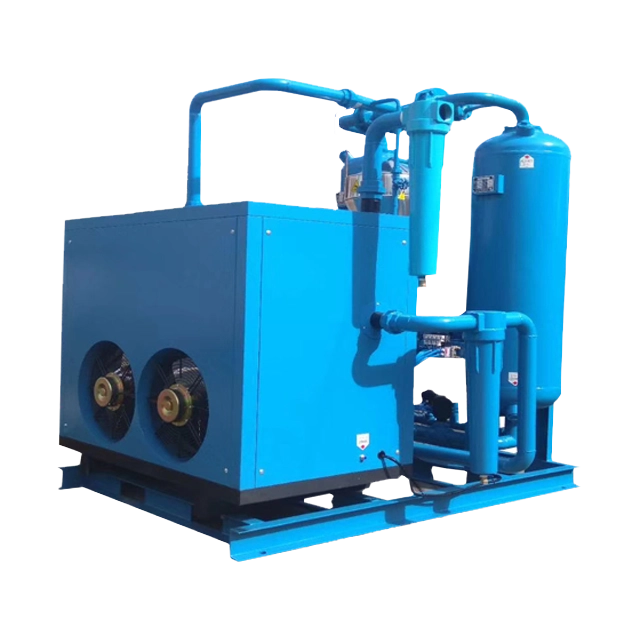
Atmospheric air naturally contains an amount of water vapor. When air is compressed, the concentration of water vapor increases significantly.
Without proper moisture removal, excess water can:
· Corrode pipelines and equipment
· Damage pneumatic tools
· Contaminate products
· Freeze in outdoor piping
· Increase maintenance costs
This is why most industrial facilities install compressed air dryers as part of their air treatment system.
Before choosing an air dryer, it is important to understand dew point.
The dew point temperature is the temperature at which moisture in the air begins to condense into liquid water.
Simply put:
The dew point is the temperature where air can no longer hold all of its moisture.
A lower dew point means drier air.
| Dew Point | Air Dryness |
| +38°F (+3°C) | Standard industrial air |
| 0°F (-18°C) | Dry air for many manufacturing processes |
| -40°F (-40°C) | Very dry air for sensitive applications |
| -100°F (-73°C) | Ultra-dry specialty applications |
The relationship between air temperature, moisture content, and absolute humidity determines the final air quality delivered to equipment.
A refrigerated air dryer removes moisture by cooling compressed air.
1. Warm compressed air enters the dryer.
2. The refrigerated air system cools the air.
3. Water vapor condenses into liquid.
4. Condensed water is removed.
5. The air exits as dried air.
This process is similar to how moisture forms on a cold beverage glass.
· Lower initial investment
· Simple operation
· Lower maintenance requirements
· Energy-efficient for general industrial use
Most refrigerated dryers provide a higher dew point of approximately:
· 35°F to 40°F (2°C to 4°C)
This level is suitable for many manufacturing facilities.
· General manufacturing
· Automotive workshops
· CNC machining
· Packaging facilities
· Assembly plants
A desiccant air dryer uses specialized drying materials to absorb moisture from compressed air.
A typical desiccant air dryer work process involves:
1. Compressed air passes through a desiccant bed.
2. Moisture is absorbed by the desiccant material.
3. Air exits with extremely low moisture content.
4. The desiccant is regenerated for reuse.
Unlike refrigeration technology, desiccant dryers remove moisture through adsorption rather than cooling.
Several types of desiccants are commonly used:
Activated alumina is one of the most popular desiccant materials because it:
· Provides excellent moisture adsorption
· Offers long service life
· Performs well in industrial environments
Used for ultra-low dew point applications requiring extremely dry air.
Suitable for moderate drying requirements and specialty applications.
Desiccant dryers can achieve significantly lower dew points than refrigerated dryers.
Common performance levels include:
· -40°F (-40°C)
· -70°F (-57°C)
· -100°F (-73°C)
These low dew point temperatures make desiccant dryers suitable for demanding industries.
| Feature | Refrigerated Air Dryer | Desiccant Air Dryer |
| Moisture Removal Method | Cooling | Adsorption |
| Typical Dew Point | +35°F to +40°F | -40°F to -100°F |
| Energy Consumption | Lower | Higher |
| Initial Cost | Lower | Higher |
| Maintenance | Simple | Moderate |
| Air Quality | Standard | Very Dry |
| Best Applications | General Manufacturing | Critical Processes |
A refrigerated air dryer is often the best choice when:
· Indoor temperatures remain stable
· Standard moisture control is sufficient
· Budget is a primary concern
· No ultra-low dew point is required
For many industrial plants, refrigerated dryers provide an economical solution for moisture management.
A desiccant air dryer is typically recommended when:
· Extremely dry compressed air is required
· Equipment operates in cold environments
· Product quality depends on low moisture levels
· Processes require very low dew points
Industries that commonly use desiccant dryers include:
· Pharmaceutical manufacturing
· Food processing
· Electronics production
· Chemical processing
· Instrument air systems
Determine the minimum dew point your process requires.
The dryer must match the compressor's airflow capacity.
Ambient temperatures can influence dryer performance.
Refrigerated dryers generally consume less energy, while desiccant dryers provide lower dew points.
Consider future production growth when sizing equipment.
A refrigerated air dryer removes moisture by cooling compressed air, while a desiccant air dryer uses moisture-absorbing materials such as activated alumina.
The required dew point depends on the application. General manufacturing often uses +38°F (+3°C), while sensitive industries may require -40°F or lower.
Activated alumina is a highly porous desiccant material used to absorb moisture in desiccant air dryers.
Most industrial compressed air systems benefit from moisture removal to protect equipment and improve air quality.
A refrigerated air dryer generally uses less energy, while a desiccant air dryer provides much lower dew points for specialized applications.
Choosing between a refrigerated air dryer and a desiccant air dryer depends on your required dew point, operating environment, and air quality objectives. Refrigerated dryers offer cost-effective moisture removal for general manufacturing, while desiccant dryers deliver exceptionally dry air for demanding applications. By evaluating your compressed air system, airflow requirements, and moisture control needs, you can select the most effective solution for long-term reliability and performance.