In industrial settings, choosing the right air compressor affects system performance, energy efficiency, and operational costs. Among the most common types are rotary screw compressors and centrifugal compressors, each with unique advantages for specific applications. Understanding their differences helps engineers, facility managers, and operators select the best solution for compressed air systems.
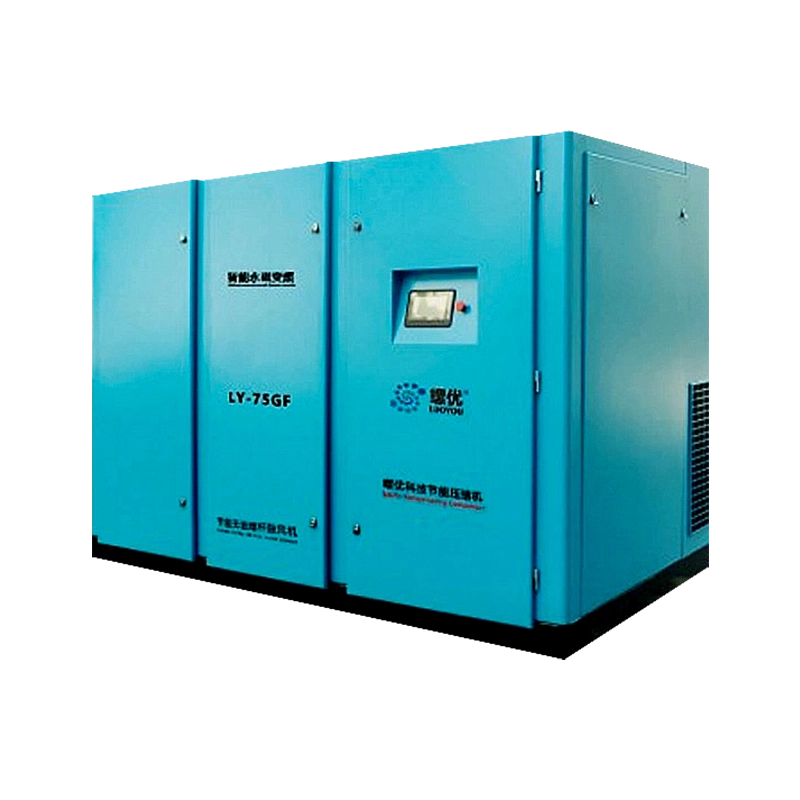
A rotary screw air compressor is a positive displacement machine that uses two intermeshing helical screws to compress air. As the screws rotate, air is trapped between the threads and the compressor housing, reducing its volume and increasing pressure.
Key characteristics of rotary screw compressors:
· Wide range of capacities for industrial use
· Suitable for high pressures and continuous operation
· Energy-efficient, especially in systems with variable demand
· Can be oil-free or oil-injected, depending on application
· Consistent flow rate for compressed air systems
These compressors are often used in factories, power generation, and chemical plants where consistent and reliable mass flow rate is essential.
A centrifugal compressor uses kinetic energy to accelerate air outward from the center of a rotating impeller. The air is then slowed in a diffuser, converting velocity into pressure. Unlike positive displacement machines, centrifugal compressors are dynamic compressors, suitable for high-volume, moderate-pressure applications.
Key characteristics of centrifugal compressors:
· Best for large-scale compressed air systems
· Smooth and continuous flow rate
· Energy-efficient at high volumes
· Primarily used in natural gas processing, chemical industries, and HVAC
· Requires careful system design to maintain performance at varying loads
Measuring the volume of fluid or air moving through a system is crucial for both types of compressors. Common considerations include:
· Rotary screw compressors: Provide relatively constant flow rate over time, making flow measurement simpler.
· Centrifugal compressors: Flow varies with system pressure; measuring mass flow rate may require more complex instrumentation.
In both cases, cross-sectional area of piping and air velocity are key factors for calculating volume of compressed air per unit of time.
| Compressor Type | Common Applications | Strengths |
| Rotary Screw | Industrial manufacturing, oil-free compressor applications, power generation | Reliable flow, high pressures, continuous operation |
| Centrifugal | Natural gas, chemical plants, large HVAC systems | High capacity, energy-efficient for high volume, smooth airflow |
Both rotary screw and centrifugal compressors can be energy-efficient when properly matched to the system:
· Rotary screw compressors often feature variable speed drives to reduce energy use when demand is lower.
· Centrifugal compressors maintain high efficiency at large scales but may need additional control systems to adjust flow and avoid energy waste.
Optimizing compressed air systems for both types includes monitoring flow rate, avoiding leaks, and maintaining proper cross-sectional area for pipelines.
1. Can a rotary screw compressor handle high pressures?
Yes, rotary screw compressors are ideal for high pressures and continuous industrial operation, unlike centrifugal compressors, which are better at high-volume, moderate-pressure applications.
2. What makes a centrifugal compressor energy-efficient?
Its kinetic energy approach converts air velocity into pressure efficiently at high volumes, making it suitable for large industrial air compressors.
3. When should I choose an oil-free compressor?
Use an oil-free compressor when air purity is required, such as in food production, pharmaceuticals, or clean power generation.
4. How is flow measured in compressed air systems?
Flow measurement depends on the mass flow rate, volume of fluid, and cross-sectional area of the system. Rotary screw compressors are easier to measure due to consistent flow, while centrifugal compressors require more complex instruments.
5. Can rotary screw and centrifugal compressors be used together?
Yes, in complex industrial systems, rotary screws can handle intermittent loads, while centrifugal compressors supply high-volume air, ensuring flexibility and energy efficiency.
Conclusion
Choosing between a rotary screw and centrifugal compressor depends on system size, flow rate, required pressure, and operational efficiency. Rotary screw compressors excel at high pressures and continuous operation, while centrifugal compressors provide smooth airflow for high-volume, lower-pressure applications. Optimizing compressed air systems with the right type improves performance, reduces energy consumption, and ensures reliability across industrial operations.